By VastuLand Real Estate Experts
Every single year, thousands of tenants in Delhi, Noida, and Gurgaon sign rental agreements they later deeply regret. Some discover hidden maintenance charges that double their monthly outflow. Others find the promised amenities were completely fabricated. And some fall victim to outright rental fraud, losing their security deposits to landlords who vanish. This definitive 2026 checklist of the top 7 things to verify before renting a PG or flat is your complete protection guide. Read it carefully, save it, and follow it without exception.
1. Verify the Landlord's Identity and Property Ownership
This is the single most important step in the entire rental process and the one most commonly skipped by eager-to-move-in tenants. Before you pay a single rupee, you must confirm that the person renting you the property actually owns it.
- Ask for the Property Tax Receipt: Every legitimate property owner in Delhi pays an annual Municipal Corporation of Delhi (MCD) property tax. Ask to see the most recent receipt. The name on the receipt must match the person claiming to be the landlord.
- Check the Sale Deed or Registry: For higher-value properties, ask to see a copy of the property's sale deed. This is the legal document that proves ownership. The landlord's name must appear as the registered owner.
- Verify via the Housing Society: If the flat is in a gated society, visit the Resident Welfare Association (RWA) or society management office and confirm that the person is indeed the registered owner of that flat number.
2. Inspect All Utilities and Infrastructure Thoroughly
Never trust what a landlord tells you about utilities. Always physically test everything yourself during your inspection visit.
- Turn on every tap: Check water pressure in the kitchen, bathrooms, and if applicable, the terrace. Ask if the building has a borewell or is dependent entirely on Delhi Jal Board (DJB) supply, which can be irregular.
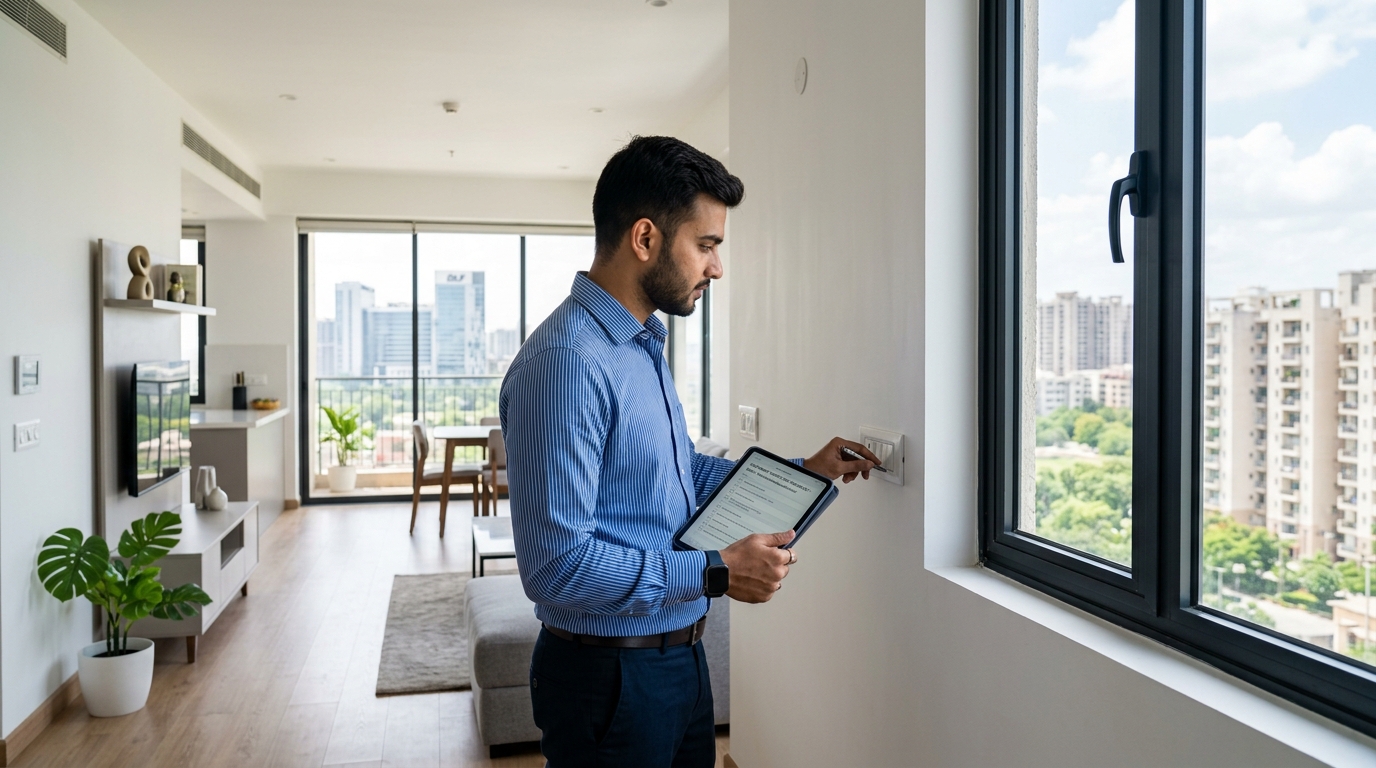
- Test every electrical switch and socket: Check that all fans, lights, air conditioners, and geysers are fully operational. Repair costs often get passed on to tenants after move-in.
- Check mobile network signal: In some older buildings with thick concrete construction (common in older Delhi localities), mobile signal can be surprisingly poor inside rooms. Check your network bars in the exact room you will be living in.
- Ask about the electricity meter: Confirm whether the flat has a separate individual electricity meter or is on a shared sub-meter. Sub-metering arrangements are often opaque and can lead to inflated bills.
3. Read the Rent Agreement Word by Word
A rental agreement in Delhi, Noida, or Gurgaon is a legally binding contract. Signing it without reading it fully is equivalent to signing a blank cheque.
Critical clauses to look for and verify in your rental agreement:
- Monthly Rent and Due Date: The exact rent amount must be clearly stated in both figures and words to prevent later disputes.
- Maintenance Charges: Are maintenance charges included in the rent or charged separately? And how much exactly? Many landlords quote a low base rent but then add ₹2,000 to ₹5,000 per month in opaque maintenance charges.
- Annual Rent Escalation Clause: Most agreements include a clause for a 5% to 10% annual rent increase. Ensure this percentage is capped and clearly stated.
- Security Deposit Refund Conditions: The agreement must state exactly when and under what conditions your security deposit will be refunded (typically within 15 to 30 days of vacating).
- Notice Period: Confirm the minimum notice period required from both sides before vacating or evicting. 30 days is the standard for Delhi NCR rentals.
4. Assess the Safety and Security Infrastructure
Physical safety of the property is paramount, especially for solo tenants and women living alone.
- CCTV Coverage: Check that functioning CCTV cameras cover the main building entrance, parking area, and stairwells. Ask the landlord how long CCTV footage is stored (ideally 30 days minimum).
- Quality of the Main Door Lock: The main door of your flat should have a heavy-duty deadbolt lock. Cheap pin-tumbler locks that came with the flat originally should be replaced immediately (which you can do at your own cost).
- Building Guard: Does the building have 24/7 security personnel? This is standard in gated societies in Gurgaon and Noida but varies significantly in standalone Delhi buildings.
- Fire Safety: Check for fire extinguishers in common areas and stairwells. In multi-story buildings, ensure fire exits are clearly marked and not blocked.
5. Check Neighborhood Infrastructure and Commute
Your flat could be beautiful, but if it adds 2 hours of commute to your daily routine, your quality of life will suffer significantly.
- Test the actual commute: Do a test commute to your office or college during actual peak hours (8 AM to 10 AM) before finalizing the flat. Distance in kilometers is deceptive in Delhi traffic; time is what matters.
- Distance to Metro Station: Walking distance to a Delhi Metro station (ideally under 15 minutes) is one of the single most important factors determining the quality of your daily life as a renter in Delhi.
- Proximity to Essentials: Verify that a grocery store, pharmacy, and medical clinic are within a 10-minute walk or convenient auto-rickshaw distance from the property.
6. Understand All Hidden Charges Before Signing
The advertised rent is never the full story. Always ask explicitly about every potential additional charge:
- Monthly society maintenance charges
- Parking charges (often ₹500 to ₹2,000 per vehicle per month in Gurgaon)
- Water charges (especially in buildings with private borewells)
- Generator/DG set backup usage charges
- Housekeeping or cleaning charges (in managed PGs)
7. Check the Vastu Orientation of the Property
This final point is often dismissed by first-time renters but is deeply valued by experienced Indian tenants. A Vastu-non-compliant home can create subtle but persistent negative energy that manifests as recurring health issues, financial stress, and interpersonal conflicts among flatmates.
- Main Entrance Direction: An entrance facing North or East is the most auspicious as per Vastu. These directions receive maximum morning sunlight (Prana) and positive electromagnetic energy.
- Kitchen Direction: The kitchen should ideally be in the South-East corner of the flat, which is the Agni (fire) zone. A kitchen in the North-East or South-West can create health and financial problems respectively.
- Master Bedroom: The main bedroom should be in the South-West of the flat for maximum stability and restful sleep.
Conclusion: Protect Yourself, Rent Smarter
Using this 7-point checklist methodically before signing any rental agreement in Delhi, Noida, or Gurgaon will save you from the vast majority of rental problems that plague unprepared tenants. Take your time, ask the hard questions, and never let a landlord rush you into signing. A legitimate landlord with a quality property will never object to a thorough inspection. Only the ones with something to hide will.
Frequently Asked Questions:
Q: What should I do if my landlord refuses to return my security deposit?
A: File a complaint with the local Rent Controller or pursue the matter in the District Consumer Forum. With a registered rent agreement as evidence, the legal process strongly favors the tenant in cases of unjust deposit withholding.
Q: Is it mandatory for the landlord to do police verification in Delhi?
A: Yes. Under Delhi Police regulations, every landlord renting to a new tenant is legally required to submit the tenant's details for police verification. Failure to do so is a criminal offense for the landlord.